Monstera deliciosa · photographed 11 September 2011
Growth joins
an older stem.
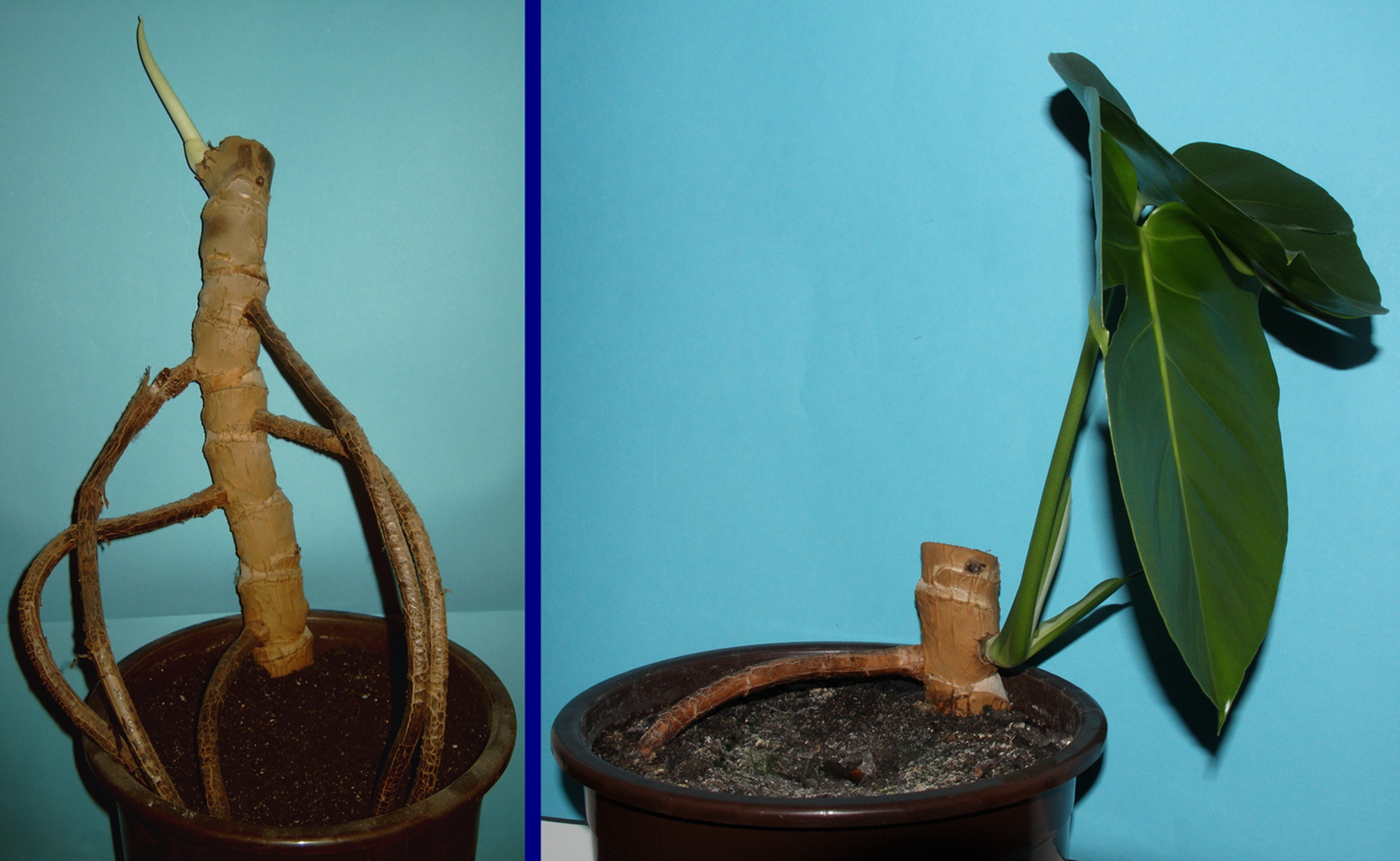
Sönke Kraft (Arnulf zu Linden) · 11 September 2011 · CC BY-SA 3.0. Both panels remain intact. The display copy is resized; the image link opens the unmodified original.

This is the new shoot.
Follow it down to where it emerges from the side of the old stem. It is not one of the brown cords below.
These are roots.
They join the stem too, but carry no leaf blades. Roots alone do not establish a new leafy shoot: some detached leaves can root without forming new stems and leaves.
Another shoot — after intervention.
The photographer identifies the left as the first sprout and the right as the sixth, after sprouts 1–5 were cut off. The picture is not an untouched before-and-after sequence.
No elapsed time is given. It documents where this growth joined, not a timetable or instructions to repeat those removals.
Keep the sequence with the picture.
A caption can preserve both what is visible and what the photographer changed. This note stays with this particular photograph.
Monstera deliciosa — an observation of attached growth
In the left panel, a pale shoot emerges from the older stem. The brown cords below are roots. In the right panel, a green leafy shoot is attached to a stem section.
The photographer identifies the left as the first sprout and the right as the sixth, after sprouts 1–5 were removed.
This record supports an observation of attached growth. It gives no elapsed time and does not establish that removal caused the later shoot or that another cutting will grow.
Photograph: Sönke Kraft (Arnulf zu Linden), 11 September 2011. Photo license: CC BY-SA 3.0. Both panels remain intact.
Image record: https://commons.wikimedia.org/wiki/File:Monstera_deliciosa_stammstecklinge_1_6.jpg
Photo license: https://creativecommons.org/licenses/by-sa/3.0/
Original observation note: LeafJoin / MoneyHunter. Keep the photograph credit and source with the note.
A second photograph needs the same landmark.
A root appearing between photographs is evidence of a root. A new leafy shoot is a different observation. Keep those outcomes separate when recording your own cutting, especially if the old leaf remains green throughout.
Before the first photograph
Give the cutting a name such as M1. Record the species, what you think was retained, and what you can actually see. “Node with a visible bud” is a more useful description than “one healthy leaf.” If the attachment is hidden, write “not visible”; do not pull apart or cut the specimen to improve the record.
Choose a permanent landmark: the old leaf's attachment, an existing scar, or a bend in the stem. Photograph it from a repeatable side, with a ruler beside rather than against delicate growth. Keep the original full view as well as any close-up.
On each return
Start from the same landmark. Describe the position, shape and attachment of anything new before naming it. “Pale point beside the old leaf attachment” is an observation; “a successful new plant” is a conclusion that the picture may not yet support.
Record your actual date, not an expected growth day. Note any change in container, medium, location or removed tissue between photographs. A changed setup is still useful to record, but the sequence no longer isolates one cause.
Two entries that should not be merged
Invented teaching example, not a growing trial. Entry A: “M1, three narrow pale structures extend below the old stem; no new leaf blade visible.” Entry B: “M1, same scar in view; a folded green structure now joins the side above the roots.” A supports a root observation. B adds a possible shoot observation that can be checked as its form becomes clearer. Neither entry establishes how another plant will respond.
Now imagine a detached Monstera leaf with roots but no retained stem node. Repeating its photograph does not turn it into a bud-bearing cutting. University of Minnesota Extension identifies a node as necessary for Monstera propagation. This is species-specific: Illinois Extension describes leaf-cutting plants such as African violet forming young plants at the leaf or petiole base.
Take the blank attachment-and-growth record · TXT
The record leaves timing and outcomes blank. It helps you describe a sequence accurately; it is not a care schedule, diagnosis or promise that a cutting will grow.
Keep the attachment with the observation.
A rooted leaf and a bud-bearing stem portion are not the same piece. ↙